Nursery sleep setup
Mini-Crib Fit: Measuring for a Secure, Well-Fitted Sleep Setup
A mini crib may look like a small version of a familiar cot, but its dimensions—and the mattress made to fit them—can differ from one model to another. Before a baby sleeps in it, check the manufacturer’s measurements, the actual sleep surface, and the way the bedding fits. In this corner of nursery planning, a few careful measurements matter more than a confident guess.
Published 22 November 2026
Why mini-crib fit deserves its own check
The phrase “mini crib” sounds precise. It is not, by itself, a promise that every mini-crib mattress or fitted sheet will fit every mini crib. Products sold under that description can vary in length, width, corner shape, depth, and construction. Some are designed for a specific frame; others are described by nominal dimensions that may not tell the whole story. A mattress that appears close enough in a product listing can still be wrong for the cot in front of you.
That distinction is easy to overlook while assembling a nursery. A room’s largest objects announce themselves: the cot, the wardrobe, the pram. The mattress is quieter. It arrives rolled or wrapped, or sits in a listing with a neat set of measurements. The temptation is to treat those numbers as a formality. But a baby’s sleep space depends on a firm, flat surface and bedding that fits as intended, without gaps or loose fabric.
Begin with the cot manufacturer’s instructions. Find the exact model name or number, then check which mattress dimensions and types the manufacturer specifies. If the cot has been handed down, bought second-hand, or separated from its paperwork, look for a label on the frame and seek the current instructions from the manufacturer. Do not rely on a general description such as “mini,” “portable,” or “travel” as a substitute for model-specific information.
This is a practical guide to checking a mini crib mattress and its bedding—not a substitute for the cot’s instructions or current infant safe-sleep guidance. Where the two seem to conflict, pause and contact the manufacturer or a relevant safety service before using the setup.
Start with the cot, not the sheet
When comparing a mini crib mattress, read the product label and manufacturer’s specifications carefully. Distinguish between the mattress’s stated size and the usable sleep surface inside the cot. The cot’s overall exterior dimensions are not the dimensions of the space the mattress must occupy; rails, end panels, and corners take up room. Likewise, a mattress measurement in a retailer’s listing may be rounded, may describe a different version, or may not include details about shape and firmness.
Use this sequence before buying or setting up bedding:
- Identify the cot’s exact make and model, including any version or production details shown on its label.
- Read the cot manual for its approved mattress dimensions, mattress type, and any limits on thickness or construction.
- Check the mattress maker’s stated dimensions and confirm that it is intended for that cot or matches the required measurements.
- Check the fitted sheet’s stated mattress size and compatibility. A sheet described for a standard cot should not be assumed to fit a mini crib.
- Keep the packaging or product details until you have checked the assembled setup and confirmed that all components are suitable.
If the cot has a rectangular sleep area, measure the interior length and width at the points and in the manner described by its manufacturer. Do not measure across the outer frame and subtract an estimate for the rails. If the mattress has rounded corners, a contoured edge, or a non-standard outline, confirm the intended shape rather than relying on length and width alone. A tape measure can help verify a purchase, but it cannot establish that an unapproved mattress is safe for a particular cot.
Measurements are most useful when they answer a specific question: Does this mattress match the dimensions and construction specified for this cot? They are less useful when treated as permission to improvise. Do not trim, fold, compress, or otherwise alter a mattress to make it fit. Nor should a gap be filled with towels, rolled blankets, foam, or other homemade packing. If the mattress does not fit correctly, stop and obtain the correct mattress or ask the manufacturer for guidance.
How to check the mattress fit
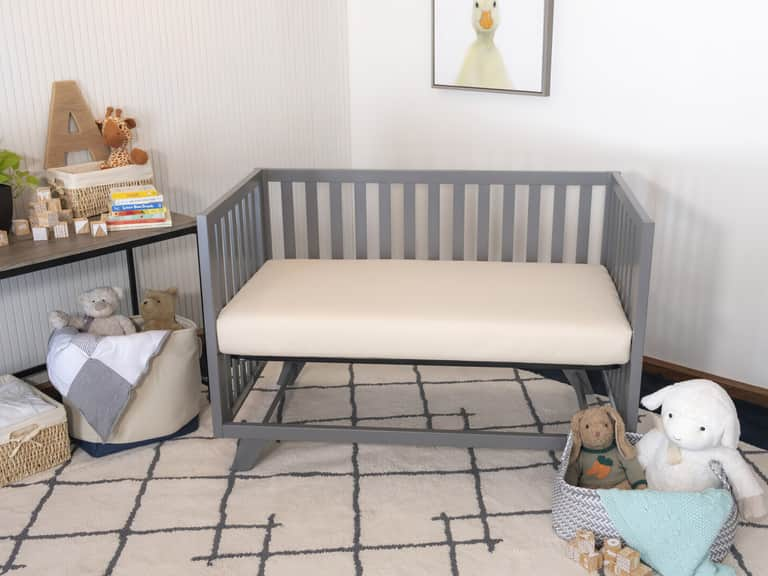
Once the cot is assembled according to its instructions, place the intended mattress on the correct support base. Check that it lies flat and sits evenly, with no corner lifted and no edge forced upward by the frame. Look all the way around the perimeter, not just at the side nearest you. A mattress that appears close-fitting at one end may reveal a gap at another, particularly if the cot or mattress is not square or the mattress has shifted.
Use the cot manufacturer’s fit guidance as your reference. There is no universal measurement that can safely be applied to every mini crib, every mattress design, and every set of instructions. If the manual specifies an allowable gap or a particular fit check, follow it exactly. If it does not, and you see a space, movement, an uneven edge, or uncertainty about compatibility, contact the manufacturer before using the cot. Do not invent a threshold based on a casual test or an online rule meant for another product.
Press gently on the mattress surface and inspect how it sits when released. The purpose is not to stress-test it, but to notice whether it shifts, bows, or lifts at the edge. Check that the mattress is supported as intended and that the base is in the position specified for the baby’s age and development. Follow the manual’s instructions for assembly and adjustment; a mattress that seems stable in an incorrectly assembled cot is not a satisfactory fit.
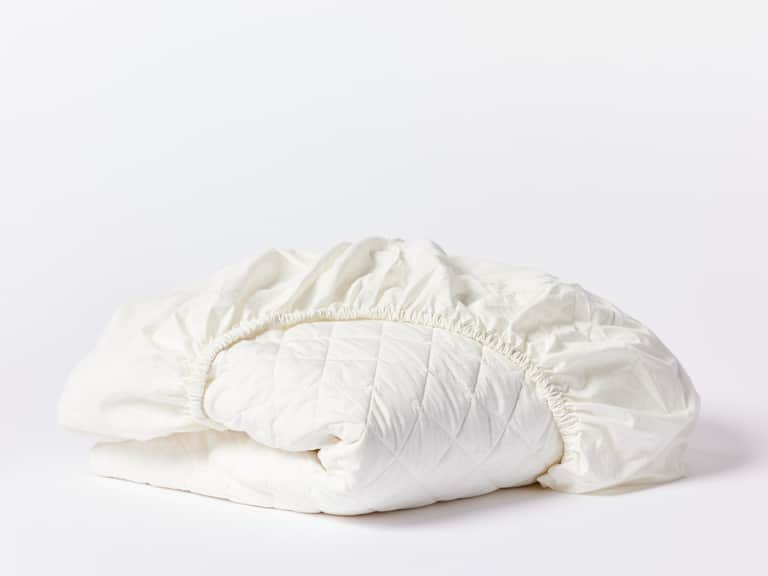
Fit can change after bedding is added. A fitted sheet should be made for the mattress’s dimensions and should stay taut and secure when correctly installed. Smooth the surface and inspect the corners and sides. If a sheet pulls a mattress out of position, bunches noticeably, cannot be secured, or leaves excess fabric, remove it and find one made for the mattress. Never pin, tie, tuck, or clip a loose sheet into place as a workaround.
After moving the cot, changing the mattress height, or laundering and replacing the sheet, take another moment to check the setup. It is an unglamorous ritual, like checking that a door has latched. Its value lies partly in repetition: the sleep space is assessed as it is now, rather than assumed to be as it was last week.
A fitted sheet is not a universal accessory
Crib bedding often looks interchangeable on a shop page. In practice, a fitted sheet depends on more than the label “cot sheet.” It must correspond to the mattress’s length, width, shape, and depth, and it must be intended for that type of sleep surface. A standard cot sheet may be too large for a mini-crib mattress; an especially deep or bulky mattress may present another mismatch. Check the sheet’s stated dimensions and the manufacturer’s compatibility information rather than assuming that elastic will resolve the difference.
Elastic should hold the sheet in place without distorting the mattress or pulling the corners upward. Once fitted, check that the sheet remains snug across the surface and around the mattress edges. If it rides up, springs loose, forms substantial folds, or cannot be secured at all corners, it is not a good fit. Replace it with the correctly sized sheet rather than adding a second layer to disguise the problem.
A waterproof layer, mattress protector, or quilted pad also changes what sits between the baby and the mattress. Before using one, check whether the cot and mattress makers permit it and whether it is specifically designed for the dimensions and use involved. An accessory marketed as organic, breathable, washable, or protective is not automatically suitable for an infant sleep space. Material descriptions do not override fit or safe-sleep requirements.
For a clear, uncluttered sleep surface, follow current UK safe-sleep advice and the cot’s instructions. In general, the baby’s sleep space should not contain loose bedding or soft objects such as pillows, duvets, toys, or cot bumpers. Do not add a topper or extra padding to change the feel of the mattress. A product intended to make a surface softer, cosier, or more luxurious may be inappropriate for an infant. When in doubt, consult current advice from the NHS or The Lullaby Trust, as well as the product manufacturer.
Firmness, flatness, and the temptation to customise
A mattress should be firm, flat, and suited to the cot. “Firm” is a functional description, not an invitation to judge a product by a quick squeeze in a showroom or by an adult’s preference. A surface that feels comfortable to an adult may not be appropriate for an infant. Use the cot and mattress manufacturers’ specifications, and avoid products that are sagging, damaged, misshapen, or of uncertain history.
Second-hand equipment calls for particular care. Ask for the cot and mattress model details, manuals, and evidence that the mattress is the one intended for that cot. Inspect the mattress for tears, broken seams, dampness, mould, exposed filling, or signs of distortion. Check that it lies flat and still fits the frame. If its condition, origin, or compatibility is unclear, do not rely on a reassuring appearance alone; seek advice from the manufacturer or choose a suitable replacement.
It can be tempting to adjust a mattress as a baby grows or as a room’s temperature changes. Keep those adjustments within the instructions. Do not place a rolled towel under the mattress to create an incline, or add padding to raise or soften the surface. A cot should not be modified with improvised supports, and the sleep surface should not be tilted unless a medical professional has specifically advised an arrangement and explained how to carry it out safely.
For newborns and young infants, safe sleep is not a design trend. The priorities are an appropriate cot, a firm and flat mattress that fits it, and a clear sleep space. Stylish colours, natural fibres, and decorative finishing may be appealing, but they are secondary to correct fit and safe use.
What material labels can—and cannot—tell you
Once compatibility is established, material information can help you compare options. Look for a full description of the mattress core, cover, and any coatings or waterproof layers. Ask whether the cover can be removed, whether the mattress itself can be cleaned, and which care methods are permitted. If the maker provides certification details, verify what the certification covers rather than assuming it applies to every component of the product.
Terms such as “natural,” “organic,” and “non-toxic” can be useful starting points for questions, but they are not substitutes for dimensions, construction details, or safety instructions. A certification may apply to a particular textile or supply-chain standard, rather than the complete finished mattress. Read the scope and the product documentation. For families looking to reduce particular exposures, a precise material disclosure is more helpful than a broad marketing phrase.
In the UK, check that the product is intended for use as an infant cot mattress and is supplied with the information needed for safe use. Confirm the manufacturer or responsible seller, the model identification, and any relevant conformity and safety information. If a listing is vague about whether the mattress is for a mini crib, travel cot, bedside cot, or another product, ask before ordering. These names may describe different designs and are not necessarily interchangeable.
Natural fibres do not guarantee a better fit or a safer sleep arrangement; synthetic materials do not, on their own, establish that a product is unsuitable. Evaluate the actual product against the cot’s specifications and current guidance. Comfort claims, breathability claims, and environmental claims should be read with the same calm attention you bring to the measurements.
Care, laundering, and keeping the fit consistent
Care instructions matter because washing can affect the bedding’s size, shape, and performance. Before the first wash, check the label for temperature, detergent, drying method, and any warnings about bleach or fabric softener. Follow the maker’s directions. A fitted sheet that shrinks may become difficult to secure; one that stretches or loses elastic may no longer stay taut. Replace bedding that cannot be fitted properly after laundering.
Do not assume that a mattress is washable because its cover looks removable. Some covers are not designed to come off, and some mattresses should only be spot-cleaned. Removing an integrated cover or soaking a mattress can damage its structure or affect its safety. If an accident occurs, follow the manufacturer’s cleaning instructions and allow the mattress to dry fully before use. If moisture has reached the interior, or there is persistent odour, mould, or damage, contact the maker for advice.
Keep the manual and care label information accessible. A small note with the cot model, mattress dimensions, and sheet size can also be useful, particularly when more than one person is caring for the baby. It turns a future bedding purchase from a guessing game into a straightforward check.
A practical measuring checklist
Before the first sleep, take a slow pass through the setup. The process need not become elaborate; it should be complete.
- Confirm the cot: identify its exact model and read its assembly, mattress, and safe-use instructions.
- Confirm the mattress: check its actual stated dimensions, shape, thickness, and intended compatibility with the cot.
- Check the surface: make sure the mattress lies flat on the correct support and shows no visible damage or distortion.
- Inspect the perimeter: look around all sides and corners for gaps, lifting, or movement; follow the manufacturer’s fit test.
- Fit the sheet: use a sheet designed for that mattress, and check that it stays snug without bunching or pulling the mattress out of position.
- Review accessories: use a protector or pad only if permitted, correctly sized, and consistent with current safe-sleep guidance.
- Clear the cot: keep the baby’s sleep space free of loose bedding and soft items, following NHS and The Lullaby Trust advice.
- Ask when uncertain: contact the manufacturer or a qualified safety source rather than adapting a component yourself.
A small space, carefully considered
One of the mini crib’s attractions is that it occupies less room. Its compactness can make a nursery seem easier to organise, but it does not make the sleep surface less exacting. If anything, a smaller frame makes a mismatch more noticeable: a sheet that is merely a little loose on a larger bed can become conspicuous in a compact cot, while a mattress that is slightly too large may buckle at its edge.
The safest approach is also the least theatrical. Identify the cot, follow its instructions, match the mattress to the frame, and use bedding made for that mattress. Measure to verify, not to justify a near fit. Be cautious of substitutes, improvised padding, and claims that distract from the basic question of compatibility. When the labels are unclear or the pieces do not sit as they should, pause and ask.
In the end, a well-fitted sleep setup is not defined by a particular fibre or an elegant nursery palette. It is defined by a firm, flat surface that fits its cot, bedding that stays put, and a clear space prepared according to current infant safe-sleep guidance. The room may be small. The care taken over it need not be.